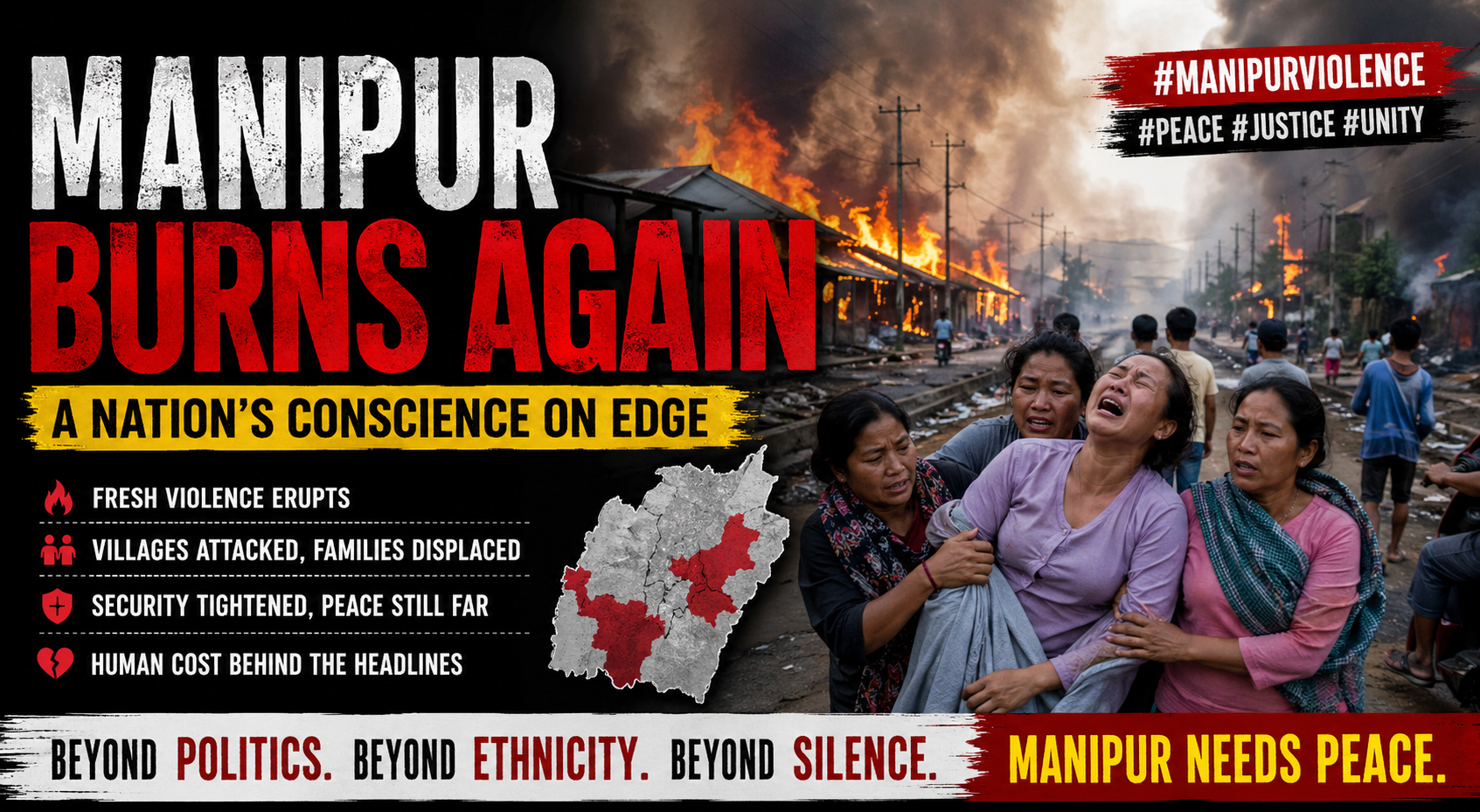
MANIPUR BURNS AGAIN: A Nation’s Conscience on Edge
The haunting images coming out of Manipur once again remind us that peace in the region remains fragile, almost like a ceasefire waiting to collapse. What began as ethnic tensions has spiraled into one of the most disturbing internal conflicts in recent Indian history. The Manipur riots, which have repeatedly dominated headlines, are no longer just a regional issue—they have become a national and global concern.
Over the past few days, fresh violence has erupted, reigniting fears among residents who had just begun to rebuild their lives. Reports of arson, clashes, and displacement have once again flooded social media platforms, making #ManipurViolence, #IndiaNews, and #EthnicConflict trend worldwide. Entire villages are being evacuated overnight, families are being torn apart, and the trust between communities seems to be eroding faster than ever.
At the heart of the crisis lies a deep-rooted ethnic divide, primarily between the Meitei and Kuki communities. What makes the situation more complex is that it is no longer just about identity—it is about land, political representation, and survival. Each fresh incident adds fuel to an already raging fire, making reconciliation seem like a distant dream.
What’s deeply troubling is the human cost. Behind every statistic is a story—children growing up in relief camps, parents searching for missing loved ones, and elderly people losing everything they spent a lifetime building. It’s easy to scroll past such news, but for those living through it, this is their reality every single day.
From a broader perspective, the Manipur crisis raises serious questions about governance, conflict resolution, and media attention. Why does it take extreme violence for the issue to trend? Why do we move on so quickly once the headlines fade? These are uncomfortable questions, but they need to be asked.
The government has deployed security forces and initiated talks, but many believe these efforts are reactive rather than preventive. While official statements emphasize control and stability, ground reports suggest a different picture—one of fear, uncertainty, and growing anger. In situations like these, trust in institutions becomes just as important as law enforcement, and that trust seems to be wearing thin.
Social media has played a double-edged role. On one hand, it has helped bring global attention to the crisis. On the other, misinformation and provocative content have often escalated tensions. The need for responsible reporting and digital accountability has never been more critical.
As someone observing this from afar, it’s hard not to feel a mix of frustration and helplessness. India, a country known for its diversity, is once again grappling with the challenge of turning that diversity into unity. Manipur is not just a headline—it’s a reminder that unresolved conflicts don’t disappear; they resurface, often more violently.
The world is watching. But more importantly, the people of Manipur are waiting—waiting for peace, for justice, and for a future where their lives are not defined by fear.
Until then, the question remains: how many more headlines will it take before things truly change?

Post Comment